To get a visitor mooring in Avalon Harbor, bring your boat to the harbor entrance and meet Harbor Patrol for an assignment. Once assigned, you secure the boat at both the bow and stern. The distinctive part is the sand line: you pull this submerged connecting line up as you work from the bow toward the stern to retrieve the second hawser.
For boaters arriving from Long Beach, San Pedro, Newport Beach, Dana Point, or another Southern California port, the arrival is easier when the skipper and line handler agree on those two jobs before entering the harbor. Here is the process, from checking availability to releasing the lines for home.
Coming from Marina del Rey? Our Marina del Rey to Avalon crossing guide covers the route past Point Vicente, passage times, shipping traffic, weather, and fuel planning.
Can you reserve an Avalon mooring in advance?
Not as a general-public visitor under the city's current policy. Moorings are assigned first come, first served. Mooring owners and their authorized designees have a separate reservation arrangement; the owner's login is not a visitor-booking system.
Check the city's Mooring Availability & Reservations page before leaving. It provides an estimate by mooring size and harbor area. An available entry does not hold a mooring for you while you cross the channel; the officer at the entrance determines actual availability.
Summer weekends and holidays fill quickly. Arriving earlier may improve your chances, but it does not guarantee a spot. Have a backup destination and enough fuel and daylight to reach it before leaving the mainland.
Avalon and Two Harbors have separate mooring operations. A process or reservation you find for Two Harbors does not establish an Avalon booking. Use Avalon's own information when Avalon is your destination.
Arriving: where to wait and who to contact
Approach the main harbor entrance and look for the Harbor Patrol boat. The city describes it as a red or red-and-gray patrol boat stationed there to assign moorings.
Stay outside the mooring field and clear of the main fairway while waiting. Keep room for ferries, shoreboats, other arrivals, and vessels leaving. An empty-looking mooring is not permission to take it.
Have your boat's name, length, and relevant dimensions ready, along with your intended stay. Tell the officer about anything that affects fit or handling, such as an unusually wide beam, limited maneuverability, or a need for pickup assistance. Confirm the assigned mooring number, its location, the approach, and payment before proceeding.
Swipe or scroll to see all columns.
| Contact or detail | What to use |
|---|---|
| Mooring assignment | Meet Harbor Patrol in person at the harbor entrance. |
| Avalon Harbor assistance | VHF channel 12; Harbor Department phone 310-510-0535. |
| Shoreboat to or from your mooring | VHF channel 9; request the service and confirm its current operation. |
| Overnight departure | Vacate by 9 a.m. unless an extension has been approved. |
The city harbor brochure says mooring assignments are not handled over VHF. Channel 12 is useful for assistance; calling it from the mainland does not get you a place in line. Keep routine harbor business off the distress/calling channel 16.
Use a wakeless speed below 5 mph, and go slower where needed for control and clearance. Follow posted restrictions and Harbor Patrol's directions.
If this is your first pickup, say so when receiving the assignment. The city specifically invites boaters to request assistance at that point. Waiting for help is easier than trying to solve an unfamiliar line arrangement between neighboring boats.
Finding your mooring number
Write down the whole identifier, including any letter prefix, and repeat it back to the officer. Ask them to point out the row, nearby landmark, and which end to approach. The city's harbor chart in its brochure helps you picture the main harbor and the outlying fields.
Have the second person look for the number on the mooring marker while the skipper watches traffic and controls the boat. Binoculars help when the markings are hard to read from a distance. Match the identifier before picking up the pole; a nearby empty mooring may be a different size or assigned to someone else. If you cannot find yours, stay clear of other boats and ask Patrol for directions.
How much does an Avalon mooring cost?
The city's published mooring fees, checked September 14, 2026, list these standard nightly rates:
Swipe or scroll to see all columns.
| Vessel length | Nightly mooring fee |
|---|---|
| 30 feet and under | $49 |
| 31–39 feet | $54 |
| 40–49 feet | $67 |
| 50–59 feet | $82 |
| 60–69 feet | $108 |
| 70–79 feet | $134 |
| 80–89 feet | $148 |
| 90–99 feet | $177 |
| 100 feet or more | $200 |
Fees are based on the vessel's length, not the size of the assigned mooring. For example, a boat in the 40–49-foot band pays $67 for one standard night or $134 for two, before any applicable seasonal offer.
The fee page also lists four-hour stays—$34 for the 40–49-foot band at the time checked—and seasonal multi-night offers. Confirm the dates, eligibility, and any approved late checkout before budgeting for those options.
Arrange payment with the officer when assigned. The city lists payment through the patrol officer, Harbor Office, and by phone. Pay before taking up the mooring or going ashore as directed.
Understand the lines before picking up the pole
Avalon's standard mooring holds both ends of the boat in position. You do not simply attach the bow to a buoy and swing around it. There are three parts you will handle:
- Pickup pole: the retrieval handle that lets you bring the mooring gear aboard.
- Bow and stern hawsers: the substantial lines that secure the boat's bow and stern to the mooring system.
- Sand line, called the spreader line in the city brochure: the submerged connecting line you pull up and follow from the bow hawser toward the stern hawser. It brings the stern gear within reach; its slack goes back into the water after both ends are secure.
The pole and the small connecting line are not substitutes for securing the proper hawsers to suitable cleats. The city's brochure describes the bow hawser as roughly six feet below the surface, so reaching the pole is only the beginning of retrieving it.
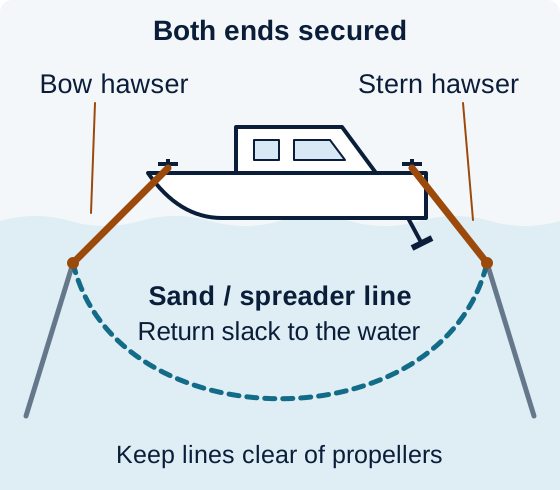
The diagram shows the boat secured, with the spreader line returned to the water. It is a simplified line arrangement, not a harbor chart or a specification of line lengths.
Two people and headsets make the pickup easier
Assign one person to the helm and one to the lines. The line handler needs to move safely from bow to stern; clear that route and the cleats before entering the field. Have suitable life jackets, a boat hook, and gloves ready. The wet sand line can be dirty and rough on bare hands.
Hands-free crew headsets are helpful, especially on a flybridge boat or when wind and engine noise make normal conversation difficult. Test them before the approach and agree on short calls: "neutral," "pole aboard," "bow secure," "stern secure," and "lines clear." Keep listening for surrounding traffic and agree on hand signals if the headsets fail.
The helmsperson stays at the controls while the line handler works. If you are alone or either person is not confident, ask Harbor Patrol for pickup assistance when you get the assignment. That is a normal service the city offers; allow time when officers are busy.
Pick up and secure the mooring, step by step
The core sequence below follows the city's brochure. The Harbor Department also links short pickup demonstrations by Newport Coast Maritime Academy; watch them with your crew before arrival if the setup is unfamiliar.
- Approach the assigned pickup under control. Follow the direction given by Harbor Patrol and account for wind and current. Bring the pole within safe reach of the bow crew. Shift to neutral before handling the lines; do not run over the mooring gear or use a crew member to stop a moving boat.
- Retrieve the bow hawser and secure the bow. Pick up the pole, then bring up the substantial bow line and put its eye on the appropriate bow cleat. Use the boat's suitable fairlead arrangement so the loaded line does not bear on a lifeline or another weak fitting. If the eye does not fit or the lead is unclear, ask Patrol for help.
- Pull up the sand line and work aft. Starting at the secured bow hawser, bring the submerged connecting line up hand over hand as you move along the side deck toward the stern. Take up its slack until you reach the stern hawser. Keep the line outside the boat and clear of feet, railings, and propellers; do not gather loose coils around your legs. Do not wrap it around a hand or body, and do not haul against a heavily loaded line.
- Retrieve and secure the stern hawser. Bring up the substantial stern line and secure its eye to an appropriate stern cleat. Secure the boat with this hawser, not the thinner sand line. If you cannot bring it aboard without straining or losing your balance, stop and ask for help.
- Check both ends and return the slack spreader line to the water. Confirm that the hawsers are seated securely, the boat has suitable clearance, and the gear is not routed across vulnerable fittings. Ask for assistance if line length, tension, or positioning seems wrong.
Wind and tide affect how the boat lies. Recheck the attachments and clearance after settling, before going ashore, and when conditions change. The city notes that line adjustments or changing sides can be necessary; have Patrol help if you are unsure how to arrange them on your boat.
If the pickup goes wrong, protect the crew first. Do not jump for the pole, lean beyond safe reach, or try to hold the boat's weight by hand. Release a line rather than be pulled overboard, keep the engine in neutral while gear is near the propeller, and only reposition when the lines and surrounding boats are clear. Call Harbor Patrol if you need assistance.
Getting ashore: dinghy docks and the shoreboat
Where is the dinghy dock?
For a straightforward landing in town, head toward the Green Pleasure Pier, the green pier projecting from the central Avalon waterfront. The city's FAQ identifies "A" dock on the west side of the pier as a dinghy tie-up. Use the signed dinghy float, not a shoreboat berth or an unmarked gap beside a commercial boat.
From your mooring, follow a clear route at wakeless speed toward the pier, staying clear of ferries, shoreboats, swimmers, and the mooring lines. From Descanso Bay, getting to that central waterfront involves a longer ride around Casino Point; assess the chop and your tender's capability before setting out. Ask Patrol to point out the appropriate dinghy dock when assigning your mooring if you are unfamiliar with the layout.
City dinghy docks have a 14-foot maximum length and 7-foot maximum beam. Keep the outboard down so its exposed propeller does not damage another dinghy, leave room for others to land, and secure your tender. A dock must be clear of dinghies from 3 to 5 a.m.; it is not an overnight storage berth. Check the signs at whichever dock you use.
How to use the Avalon shoreboat
Hail the shoreboat on VHF 9, or use the number on the city's harbor services page, currently 310-363-3935. Give your boat name, full mooring identifier, area, and passenger count: "Shoreboat, this is [boat name] on [mooring], [number] people for shore."
Confirm that it serves your location, the current fare, payment method, and last return trip. The brochure describes fares per person, each way, separate from the mooring fee. Before stepping ashore, ask which shoreboat float to use for the ride back; do not assume the dinghy dock is the pickup point. Take your mooring number and a way to contact the service with you.
The shoreboat saves launching a tender and finding dock space. It can be particularly useful from an outlying mooring, but verify service and conditions before relying on it for your return.
For loading or unloading from the main boat, eligible public floats have a 10-minute limit and the boat must remain attended. The shoreboat float is not a general loading berth.
Staying aboard, quiet hours, and the 5 p.m. horns
Around 5 p.m., you may hear boat horns marking happy hour, a local boating tradition visitors often notice. It is an informal custom, not an official harbor announcement or a signal that it is safe to depart. Let required navigation and warning signals remain clear, and be considerate of neighboring boats.
Plan for a mooring stay without shore-power or dock-water hookups. Bring enough battery capacity, water, and holding-tank space for your intended stay. Standard generator quiet hours are 10 p.m. to 7 a.m.
Avalon enforces a no-sewage-discharge policy. Its dye-tabbing procedure requires dye tablets and a test flush in each marine head on vessels equipped with a holding tank. Have the sanitation system properly configured to retain waste before arriving, and arrange pumpout as needed. Dye testing does not replace the skipper's responsibility to prevent discharge.
Stay reachable and able to respond promptly if Harbor Patrol needs you back aboard. An assigned guest mooring can require relocation; a multi-night payment does not guarantee that exact location for the entire stay. Do not leave the island with the boat unattended.
If Avalon is full: Descanso Bay and anchoring
On busy summer weekends and holidays, you may be offered a mooring farther from the central waterfront, including Descanso Bay or Hamilton Cove. Ask where it is before accepting, how exposed it is in the forecast, and how you will get ashore.
Descanso Bay is beyond Casino Point and can be rough and rolly. Wind, swell, and passing wakes can make the stay less comfortable and the tender trip wetter than expected. It is not equally rough every day, but assess the conditions for your boat and crew rather than assuming an outlying assignment offers the same protection as the inner harbor. Ask Patrol about conditions and whether a move closer in might become possible; a move is not guaranteed.
If no suitable mooring is available, anchoring in a permitted area may be an option. Avalon's FAQ describes the city anchorage west of the red jetty light on the Casino breakwater, with 80–120 feet of water and at least 300 feet of separation from a dive park or mooring can. These are deep-water anchoring conditions: you need enough rode for the required scope, suitable ground tackle, and swing room. Confirm the approved zone with Patrol and use current charts; do not anchor among the moorings, in the fairway, or in a dive/swim area.
If that anchorage does not suit your boat or the weather, use your backup destination. Two Harbors has a separate mooring operation and requires its own availability check and passage plan.
The city explicitly warns that Avalon is not a safe harbor during adverse weather. Check the National Weather Service's Southern California marine forecasts for the route, destination, and return window, and follow Harbor Patrol weather directions. A mooring assignment is not a guarantee of shelter.
Before the crossing, use our boat maintenance checklist to check steering, pumps, leaks, engine operation, and open repairs. A short shakedown after recent work is a better place to discover a fault than midway to Catalina.
Leaving the mooring
Normal checkout is 9 a.m. on departure day. If you want to stay later, arrange an extension with Patrol or the Harbor Office before 9 a.m.
Prepare the boat and crew before releasing anything. Check surrounding traffic and your clear departure path. The city's standard departure sequence is:
- Release the stern hawser first.
- Release the bow hawser, returning the gear to the water.
- Watch the hawsers and spreader line sink clear of the propellers and other running gear before engaging propulsion.
Keep the engine in neutral while released lines are still nearby. Do not reverse across the gear you just dropped. If wind, current, or a tight position makes the standard sequence difficult, request assistance before casting off.
Sources and scope
- City of Avalon: availability and reservations, about the harbor, and visitor FAQ—assignment, assistance, checkout, anchoring, and visitor arrangements.
- Avalon Harbor brochure and city pickup-video page—mooring gear, securing sequence, departure sequence, and channels. Written pickup instructions above are based on the brochure.
- City of Avalon: mooring fees, harbor services, harbor-related municipal codes, and dye-tabbing policy.
- NWS Los Angeles/Oxnard marine weather—coastal forecasts and buoy observations for trip planning.
Official information checked September 14, 2026. The headset advice, busy-period planning, Descanso comfort notes, and happy-hour custom are practical visitor context, not city rules. Prices and harbor operations can change. The city FAQ/brochure use a 5 mph limit, while its municipal-code summary says wakeless or under five knots, whichever is less; this guide recommends a wakeless approach below 5 mph. Follow Harbor Patrol's current directions and posted restrictions.